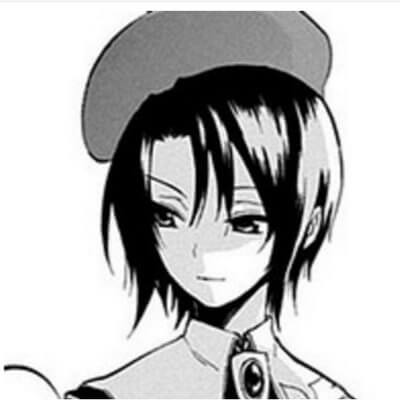

This note contains semi-public thoughts.
It is personal and subjective, like a diary entry, but I still hope it can be enjoyed and understood by strangers online. Feel free to share it around with friends or in communities you’re a part of!
Just bear in mind that this remains a piece of personal writing at the core. It most likely deals with something I care for, or I wrote it in the hope that it would speak to other people… but I cannot guarantee that this will be the case at all.
Shinsekai Yori (新世界より, “From the New World”), a critically-acclaimed horror-adventure anime series by A-1 Pictures from 2012, has been a favourite of mine ever since I first watched it in Spring 2021.
I was in a mid-pandemic in-between at the time, at the end of a short-lived study-professional path I found soul-deadening, sitting on a mountain of unprocessed family dysfunction, and stuck at home during a months-long building façade renovation, which obstructed daylight entirely during the whole of winter.
My distant father still dropped in unannounced for long, strange weeks, while we lived with my increasingly paranoid mother who I really thought for a time we were about to lose, with no concrete footing to be found, a dwindling link to tangible reality. The mismanaged pandemic and its toll, the erratic curfews imposed during winter, and the very concrete isolation to the outside prompted by the lack of daylight all fused and gave tangible shape to her paranoid delusions —delusions I could not even name as such in her presence, lest I further push her away in a world of reality-denial.
I had already struggled for years and years to make sense or explain the very bizarre but mundane shape of family dysfunction I swam through daily, even to close friends1, and it was reaching unliveable levels.
Still, I had time (the most precious gift!), no professional obligations for a while until I figured again what to do, so at least I could indulge in a few anime/VN watches or reads to distract me.
Seeking concealed truths in the realm of fiction
Shinsekai Yori, chiefly concerned with mind-shattering truths that one cannot convey, came at just the right time and hasn’t really left me ever since.
It’s become one of the largest pieces in my perpetual “quest for truth” horror obsession.
Anything Gnostic, occult or Gothic shaped about reaching a higher truth about the self, or the world, that’s always been concealed; the cost of seeking it; and the much higher cost of not believing it, of not believing in time.
It’s a staple of philosophy, horror, art that comes in many, many shapes.
If you carve it wide enough, a chunk of religion falls in it.
Among others:
The myth of Cassandra, The X-Files, Close Encounters of the Third Kind, Disclosure Day, Jordan Peele’s Us, Daphne du Maurier’s Monte Verità, Joan Lindsay’s Picnic at Hanging Rock and its Peter Weir adaptation on film, the Alien movies, H.P Lovecraft: all about concealed or unexplainable truths, or the cost of (not) believing.
Obviously Plato’s cave and The Matrix.
But also: ufology, New Age beliefs and every new religious movement since theosophy, modern conspiracy theories and their reactionary implications.
Though I don’t believe it to be inherently harmful, and many of the works I quote deal with oppressive social structures or the cost of repression, it’s also hard to deny that many (not all) real-world outgrowths of the human impulse to seek concealed higher truths are cult-like and should very plausibly be fought.
It’s hard to improve reality when part of the population decides to secede from it entirely, claiming a higher truth demands of them to damn the rest of us.
But still, all in all, in art and horror, I fall for it every single time2.
In the world of fiction, playing with belief and truth is fun. I sometimes describe the appeal of occult horror as summoning actual and true evil in front of our eyes through the screen.
If I generalise, the appeal of the horror I describe here is to summon the belief that a truth you intuit about the state of the world, or your family and its secrets, or yourself and what happened to you, is real after all, can be reached, even if the cost is high, even if no one believes it at the time.
It’s, evidently, infinitely cathartic, and it breaks my heart every time.
All this lengthy introduction is to say that Shinsekai Yori is one of the very best iterations of this brand of horror to me. One wherein the truth to be confronted with is not so much about the self but historical3; about realising the true shape of the society you live in, and whether you can accept it.
It is a tragic story but it’s become a dear comfort rewatch, and every creative project I’ve dabbled in since this first watch back in Spring 2021 has had some traces of Shinsekai Yori in it4.
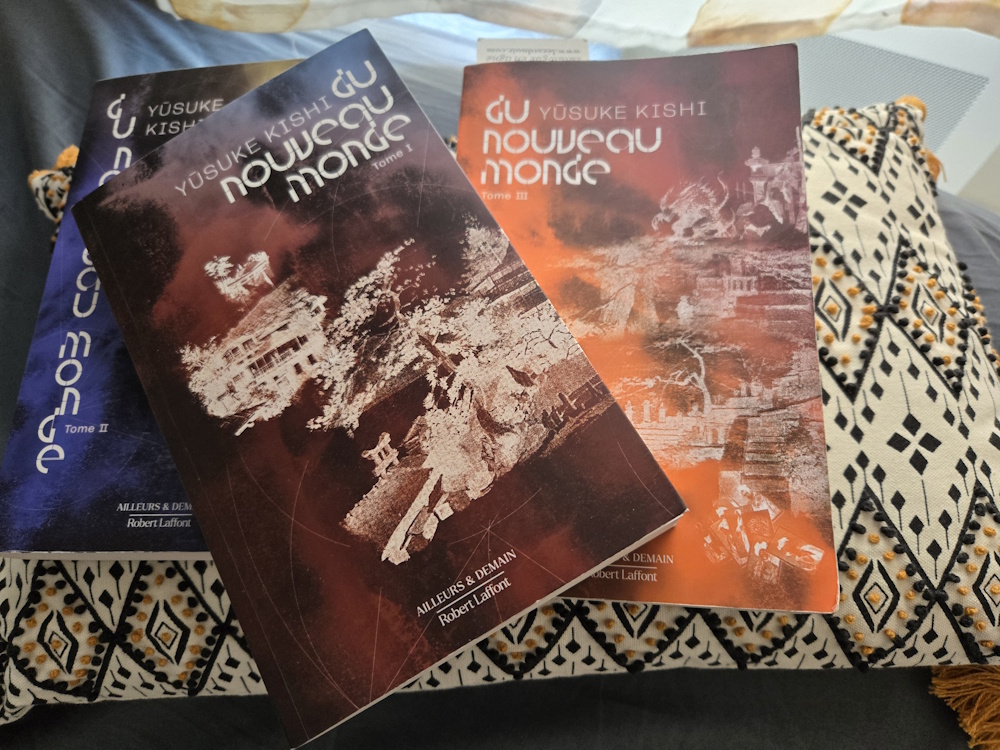
So I was super glad when the eagle-eyed Morolian realised that the original 2011 novel by Yusuke Kishi, on which the anime series is based, had in fact already been translated in French, in three volumes published by Robert Laffont (April 2024, April 2025, May 2026). The translation is by Mai Beck and Dominique Sylvain.
So I devoured the three volumes over the past weeks, and I’ve had a very good time with them. My infinite thanks go to Morolian, I owe her all the fun I had with this mini-reading project!!
Shinsekai Yori: a short introduction
About the setting
Set in Kamisu 66, a distant-future Japanese rural community steeped in mystical Buddhism, Shinsekai Yori introduces us to a world where psychokinesis has become ubiquitous within mankind, allowing adults and kids over the age of 10 to project a mental image of their choosing on the outside world to alter it.
Moving heavy weights by levitation, igniting fire to light dark rooms, creating small winds, moving a boat at high speed without any sail, repairing small objects: in the world of Shinsekai Yori, all of these are within reach of human beings, moderated only by the user’s individual skill, and by mental strain upon repeated use.
This mental power of projection, called jyuryoku, is believed to be a divine gift, and constrained by numerous ethical and religious rules.
The story is framed as a testimony of traumatic events witnessed by our protagonist and narrator, Saki Watanabe, relating to experiences and choices she and her friends made from childhood to adulthood. The entire text is left as a time capsule for future generations.
Saki explains early on that by giving as true account as she can of these events, she hopes future generations will be able to make more informed choices, and to avoid repeating the same mistakes.
Frequently throughout the story, comments upon the past by Saki, and the foreshadowing of an unconceivable loss of lives give strong hints of the dark underbelly of this world.
From moment to moment though, you get at first: happy childhood memories of Saki growing up along her friends within Kamisu 66, learning to master the jyuryoku through play; summer camp adventures; budding teenage romance and drama.
But all of this slice-of-life narrative is interspersed with increasingly worrying encounters with the taboos of Kamisu 66.
Much of the horror comes from this contrast between the initial ignorance of Saki’s friend group as children, and what both the reader and the adult Saki narrator recognise as oppressive social rules. A village-wide curfew, rituals of hypnosis, disappearances of children that are soon forgetted by everyone, a pervasive fear of whatever exists outside the “holy barrier” of the village… all of these produce a foreboding sense of unease, and sketch little by little the experience of living within a dystopian society ruled by invisible taboos, things not to mention or think about, that you only learn of through fear, more than through outright use of force.
All this is saying nothing of the sheer tour de force of worldbuilding behind the universe: there’s an impressive amount of historical and scientific internal consistency to this world.
I’ll mention the scientific-biological aspects later, but on the historical side, adult Saki narrator’s references to “the preceding civilisation” (ours) and its sins, barbaric practices and technologies, thread a link between her “peaceful” present-day and our own world, making us endlessly wonder “how did it get this way”, and for what reasons.
Before going any further: just a few words
I’ll leave my brief introduction of Shinsekai Yori at that.
If any of the ideas I sketched here piqued you interest, I can only urge you to watch the anime series, it is extremely worth it.
What follow are more specific throughts from the experience of reading the novel, first overall, then in specific, volume by volume.
I tried to write everything in a style specific enough for fans of the series to immediately get the parts I reference, but non-specific enough for new readers to grasp the essential without major spoilers either. Volume by volume impressions may still be somewhat dangerous to read about in detail, do take care when reading about Volume 3 especially.
I wrote a bit too much per volume, so do feel free to skim to whatever part interests you.
One last note: I decided not to shy away from incessant (obnoxious?) novel vs anime comparisons here. Given how much I imprinted on the anime adaptation, it was inevitable I would approach the novel only with very blinkered eyes.
The reception of the novel is bound to be very much different for novel-first readers in French or Japanese, or for avid fans of Yusuke Kishi, who’s a well-known mystery-horror-thriller writer of his own.
I can only offer my own very limited experience here, but more informed Japanese-language readers would doubtless have much more useful perspectives to share.
Overall impressions of the novel
Hints of the writer behind the narrator
You’ll have noticed that until now, I barely differentiated between the novel and the anime series when describing the shape of the narrative.
The reason for that is there was simply no need to differentiate them very much.
Having now read the novel, I can confirm how very, very close to the spirit, tone and letter of the book the anime series is. It is incredibly faithful on a scene-by-scene basis, and in terms of style, affect, everything, to the point I would still heartily recommend everyone to just start with it.
Typically, the distinctive foreshadowing and comments upon the past from the adult Saki narrator in the anime, which bring the fundamental framing of the narrative, are all directly lifted from the exact same sentences in the novel (I could instantly recognise all of them even across different translations), and they produce very much the same effect in both cases.
One thing reading the novel did bring to the surface me is more hints of the writer’s interests and voice behind the lines, through the narrator.
The very alien fauna of Shinsekai Yori is one of its worldbuilding strengths. The anime series does an incredible job of introducing it organically, letting the viewer figure it out for themselves simply by viewing the the existence of exploding balloon-dogs or of meter-long translucid snails on the screen.
The narrator from the novel brings something new to the table: an biologist-oriented perspective, adult Saki commenting upon the scientific latin names of the species she encountered as a child, and gracing us with sometimes obtuse lectures of their evolutionary history.
Skimming through Goodreads reviews of Kishi’s other novels, this habit of infodumping, as it’s sometimes in fan/writer circles, seems pretty well-known. And his interest in granting a plausible scientific basis to all the alienness of Shinsekai Yori comes clearly to light through Saki’s lectures.
There’s some narrative basis to the lecturing too: like all the other foreshadowing dropped by Saki, the question “how could species evolve so radically different from those of the preceding civilisation” has an in-universe explanation, linked to jyuryoku, but I did not expect it to take so much space on the page.
It’s hard to view it as anything other than a genuine interest of Yusuke Kishi.
Other fun threads that come more clearly to light in the novel concern inter-species relations and anthropocentrism, human sexuality, hints of political reflections on democracy/dystopia. I’ll refer to specific story beats from the novel in the following sections by volume for some of these.
But to summarise in a few words what the novel brings: it’s easier to follow how the universe of Shinsekai Yori was constructed by Kishi in the novel, and in the process some of its otherness is reduced.
The anime series is very wordy, but the audiovisual nature of the medium makes you experience the world as a genuine visitor.
You’re dragged from surprise to surprise scene by scene, forced to accept the nature of the jyuryoku, of alien species, and even of surprising character development, as they are presented to you, as a given.
You have no choice but to be shocked and be made helpless before it all. In some cases, it’s hard to interpret entirely: it just is.
But Shinsekai Yori, novel and anime alike, can be very mechanistic in its construction, it’s clearly more plot- than character-driven, and the lack of character interiority is a recurring and not entirely inaccurate criticism.
In the anime series, the flaw is softened by the visual inventiveness (especially those colours), the quiet juxtapositions of disqueting things.
The novel, with its matter-of-fact prose, scientific pondering, falls a bit more easily victim to this flaw. You’re forced through a scientific tour of the Shinsekai Yori factory by your tour guide Yusuke Kishi, and it becomes easier to see the seams around the room in certain quarters.
Some of it, I was happy to be shown.
But for a lot of it, I was more than happy with the much more violent and direct exposition from the anime series, which said just enough and let me infer the rest.
Style expectations
Returning to the lack of character interiority, I was admittedly a bit surprised by the matter-of-fact style and the overall feel of an adventure novel. Skimming through reviews from first-time readers with no familiarity with the anime series, I see several of them who describe it as a YA novel for this reason.
This is in part very funny given I’m pretty sure it’s not an editorial category either Kishi or his publisher was targeting, but I can see where these reviewers come from, too.
I’m not sure if this is due to stylistic choices in the French translation, but it seemed to me the earlier English fan translation was similar from what little I skimmed of it, so I’m inclined to say it’s really due to the source material.
I think my own surprise may come from the fact that the anime series’ wordiness is reserved for the most eloquent character moments, or for critical infodumping scenes.
So seeing these, you conceive in your mind an impression of what the novel must be like based on these best parts, divorced from the way it truly reads moment to moment.
I’m laying out criticisms first, so it might seem as if I’ve only been disappointed.
Far from it, the gears of tragedy are as superb in the novel, and the feel of adventure is excellent the further in you go.
But there is truth in the fact that the novel is at times colder and more detached than what I expected.
Volume by volume impressions
Volume 1: of war and rats
I’ll skim through the childhood years before the summer camp, which introduce the school system, the jyuryoku, the first notes of horror with schoolyard rumours of children-ravishing “tainted cats”, strange disappearances, and so on.
During the summer camp kayaking trip, Saki and Satoru end up embroiled in a war between monster rat colonies, monster rats (化けネズミ aka bakenezumi) being the subservient underclass of sentient rat species in the story’s universe.
Shinsekai Yori’s description of what’s essentially a specist slave-owner society5 has always been rich, sadly very realistic, but also rife with discordant, uncomfortable depictions of this monster rat underclass.
Much of it comes from the story’s point of view, of course:
This is a story strictly told from the slave-owner side. It deals with all the implications of this organisation very plausibly, showing everyday attitudes ranging from cruelty, arrogance, paternalistic rational handling. And through Saki’s unyielding quest for truth, the untenable cost of imposing species-wide, life-long servitude is more than obvious. Much of the maelstrom of tragedy in volume 3 stems at least in part from it.
But the monster rat wars from the first volume have always been a dark spot in the story beats for me, and I failed to clearly explain why until reading the same passage textually rather than in the anime.
After being stripped of jyuryoku for trespassing an interdict, and thus rendered helpless, Satoru and Saki are imprisoned by one of the warring colonies, and face several close calls with death. Satoru luckily recovers his power thanks to Saki, and is enrolled into helping the other colony’s side in the war, being manipulated by Squealer, a scheming adviser to the colony’s queen.
Turning to revanchist violence, Satoru proceeds to systematically annihilate enemy monster rats using the full of his power, to the dismay of Saki, who already displays a mixture of empathy and wariness for monster rats, or at least for the system that organises their indentured servitude.
It’s a passage meant to be uncomfortable, rife with war strategising, and with exacting depicitions of the mode of killing of hordes of soliders. Human violence is clearly the target; but still I found it even harder to read through than to experience in the anime, where the suddenness of it all ironically softens it.
Echoing endless debates on race in Tolkien, I think the conclusion here is that the usage of dehumanising caricatures in displaying hordes of Others systematically killed produces the predictable reification of these Others. And that happends regardless of other humanising qualities or complexity elsewhere in the work.
Volume 2: the perils of seeking the truth
The middle part of the story apparently remains just as engaging, whether in the anime series or in the novel!
Whereas the first third of the novel introduced us to the setting and to relatively “minor” rule-breaking by Saki’s friend group, the second third amps up the stakes, puts them at odds with the secretive Ethics Committee6 and the all-powerful Board of Education, and sets up the threads of tragedy of the third volume.
Closer encounters with their society’s interdicts, the introduction of the now-far-too-real tainted cats which were only schoolyard rumours until then, the elimination of undesirable children and psychic manipulation all make for great horror.
It’s all great, and made me appreciate even more the way the anime approached these parts visually.
It’s also the part where the reality of the 業魔 goma (translated as karma demon in the English subtitles of the anime) comes to light, affecting one of the friends from Saki’s group, and in turn leading to more psychic manipulation from the adults.
A notable lore addition regarding goma in the novel that’s absent in the anime series: when Shun reveals what he found out about his illness (the Hashimoto-Appelbaum syndrome7), we get a random Jungian “collective unconscious” explanation for the leakage of the unconscious to the outside world. So you can now explicitly add Shinsekai Yori to the long list of media influenced by Jungian ideas and archetypes, if only in passing.
Finally, a quick note about teenage sexuality in the novel.
One of the universe’s well-known oddities is another kind of sexual regime, that feels freeer than ours, but also very rigid in novel ways. One of the gears that supports the enforced conformity in Kamisu 66 is an apparent total sexual freedom outside of reproductive sexuality: teenagers and adults alike are encouraged to freely take lovers as they wish, of either sex. This “society of love” sustains strong intra-community ties is explained in Episode 4 to be inspired by bonobo’s well-known sexual promiscuity (more Kishi nerding about science).
On the other hand, sexual reproduction appears to be strongly regulated through prior authorisation by a community authority.
In Saki’s friend group, these bonds create an original sexual triangle, wherein Saki and Maria are lovers, Shun and Satoru too, but where Saki also strongly yearns for Shun, since childhood. Some of it is meant to feel strangely uncomfortable: the implied logic is that free sexual ties makes bearing with the enforcement of harsh, invisible rules much easier for everyone. Saki has moments of revolt against it, where she asserts inwardly “we’re not animals”.
It’s well-known among fans that the novel features more explicit sex scenes within these couples than the light hints of the anime, and I was excited to see how these were depicted.
Some of these were good, but not all: sadly, the novel makes it possible to read between the lines a yearning for the restoration for the comforts of mandatory heterosexual intercourse at times.
More generally, teenage Saki has (a few) inner reflections on her weakness as a woman, when the anime made apparent all her strengths and flaws in a more rounded way, without resorting to stereotypes. Another case of the writer unfortunately showing up between the lines.
Volume 3: where every fate is sealed
Volume 3 concerns the events Saki witnesses as an adult, and the almost complete eradication of her village at the hands of a rebellion no one expected, in a tragic callback to the violence of the monster rat wars of the first volume.
In volume 3, the knot is tied for all the set pieces positioned earlier by Kishi, in the tragedy long foreshadowed.
One notable textual difference between the anime and the novel in this part concerns Saki and Satoru’s flight on a boat, being closely pursued by the akki who killed off every human in the now-deserted hospital of the village.
In the anime, facing imminent death, Saki gives what I’ve always termed as the “I hate the Board of Education” speech.
There are other emotional speeches of the same kind in the story: Maria’s farewell letter of course, her “you have a special strength” speech as well, and their early attempts to recover erased memories upon returning to Shun’s now destroyed home.
But Saki’s “I hate the Board of Education” speech from Episode 20 has always stood apart for me as the very core of the story, and I can’t resist embedding it here directly.
The episode almost opens on it, so I clipped from the very beginning for wider context regarding the akki’s chase, but the speech itself starts at 0min50s if you want to start right on it:
Having just witnessed people she met be killed off without a second thought by another human, facing her own imminent end, Saki confronts her utter helplessness.
She bemoans two evils at once in the speech:
Not only how little her life weighs for the akki who pursues them and could incinerate them at a moment’s notice… but also the Board of Education’s cruelty in systematically eradicating children they deemed too different.
Isn’t she the same helpless prey before both the mindless akki, and in front of the Board?
At the same time, she realises that it is the primal fear of the catastrophe about to engulf them —the entire village’s destruction at the hands of a single individual— that motivated the Board. But now I know they were just afraid, she reflects; they were afraid something like this would happen.
They felt compelled to prevent it, simple as that.
So was it unavoidable after all?
It is only in the following episode that the true origin of the akki is explained as a direct result of the Board’s own fear of Mamoru, and of his ensuing flight with Maria.
So the seeds sown throughout earlier parts of the story come full circle in a tragic end, and Saki’s intimate conviction of the system’s inhumanity is proven right. It is the Board of Education’s own pathological fear, mistrust and disregard for human lives that produced the result they most feared.
As with Shun, in Shinsekai Yori, the cost of psychic repression, the disregard for human freedom is proven to be far more untenable than anything. But the choice was never Saki’s to be made: in the moment, all she has is her own helplessness; the threads of tragedy were tended much earlier.
What I found out in the novel is that part of the speech is in fact an invention from the anime series, which I did not expect at all!
The sentence I hate the Board of Education itself, which synthesises the dead end of the village’s own rules, and Saki’s capacity to confront it, is an invention of the anime.
In the novel, the original speech mentions not the Board, but a specific Board member (Hiromi Torigai) who died in the attack, and who happened to be the chief instigator of their quest to eliminate Mamoru, even Saki herself. The scale of Saki’s complaint is thus more limited to individual stakes, especially given how little the character of Hiromi means for us.
Overall, the original speech also takes a few different tangents at the same time: an emotional remembrance of Maria, whose ghost-like apparition accidentally saved Saki’s and Satoru’s lives, as well as Saki’s puzzlement regarding her altered memories.
These may seem like superficial differences, but I was very surprised to find out that what seemed to me to be the very beating core of Shinsekai Yori is almost just another character development scene in the original material.
Lastly, a very good expanded development from the novel concerns the final sequence and ending, and the nature of species-based oppressions.
On the surface, the final sequence opposes Kiromaru, a feudal monster rat military leader, loyal to humans and to traditional hierarchies, and Squealer, the Machiavellian schemer who used democratic ideals for the purposes of his monster rat uprising.
It’s shown in the anime series that the opposition is a surface one only, and that both their ideologies are forged in the same fundamental dehumanising of a sentient species. Kiromaru, who allows Saki and Satoru to retrieve a biological weapon in the underground ruins of Old Tokyo, is revealed to know these ruins so well because he himself led his troops there in the past, to retrieve a weapon to extract themselves out of slavery.
The novel expands upon that aspect further, with an even more detailed defence of Kiromaru, and with more reflection of Saki about it, to the surprise of Satoru.
Similarly, the ending sequence is rife with almost dream-like ambiguity in the anime series, with Saki shown to raise tainted cats out of need to avoid catastrophe while promising to strive for change; showing an irresoluble contradiction, but the necessity to go beyond it.
Through Saki’s interiority, the novel explores the contradiction with more depth; we get Saki’s actual reasoning, or justifications if you’re not disposed to forgive her.
The flawed resolution of the new order she belongs to is described in more detail too. Her resolve to use her power to save as many monster rats from eradication, her rejection of reactive cruelty8, appear even more clearly.
All of these are definitely hinted at in the anime, but breezed through as in a dream of ambiguity, that leaves you shocked, grasping for safer footing and for true hope.
The novel gives this resolution a different shape where the hope of change actually seems achievable, with all the uncertainty implied, but still within reach ultimately.
-
“Each unhappy family is different in its own way” remains one of the truest sentence ever written if you’ve experienced it first-hand. I’m not sure if people still remember it much, but the 2013 Twine horror game my father’s long, long, legs by Michael Lutz is still such a good short piece to convey this feeling of unexplainable family dysfunction. Art really is one of the best ways to emerge out this mental haze, to realise it can and will end, and that one is not alone after all. ↩
-
My infinite fondness for Disclosure Day, despite public chillness for its cloying resolution, definitely comes from that. I freely admit I’m so fond of this device that it can blind me to other flaws in the story.
Returning to my mother for a minute, and considering her strange mix of outward practical pragmatism and hidden faith, her (now quite cured) delusional moments, I think it’s pretty clear that in another life I could be a fervent follower in terrible cult-like New Age-style groups.
I’m super lucky to be obsessively interested in that stuff in the realm of fiction above all. ↩ -
This could lead us to Gothic horror territory, which I also love to death and gobble up like eyecandy, but there’s very little haunting of the past in Shinsekai Yori, which bears the shape of tragedy. It’s a story from right after the catastrophe has occurred, and all about confronting the unavoidable. ↩
-
Blooming Chasm, now on hiatus, was begun in May/June 2021 and is 100% Shinsekai Yori-shaped. If you’ve seen the anime, this should be obvious from the VN’s synopsis.
On Mount Ségou reuses the form of the critical revelations from Episode 4 (“Bloodstained History”) when the bride learns the truth about her airborne imperial society.
And my current WIP project, Célia’s Story Nights (an offshoot from Sylvan Disappearance), also reuses key structure from the Shinsekai Yori tragedy within a Werewolves-style murder party game, run by Célia in the course of the story. More on this in the following weeks, hopefully! ↩ -
Albeit one where slavery is a communal institution; private property is not much of a thing in this universe. Rat-monster/humans relations are fundamentally imbalanced, but they all go through fifteen layers of administrative handling. ↩
-
I’ll mention that the French translation translates this generic “倫理委員会” (which could be used in everyday medical research context) as “Commission de la Morale” instead.
I have a strong feeling “Morality Committee” would definitely not work in English, but it’s an interesting choice in French, which gives a stronger hint of the ruling normative power of the Committee in question than a more neutral “Comité d’éthique” would.
It gives off a whiff of old-fashioned Vichy government conservatism, which isn’t far off the mark at all.
Researching this also led me to the short-lived “ordre moral” coalition of monarchist right parties in the budding 3rd French Republic: again, a nice echo. ↩ -
Kishi gives more scientific grounding to his universe and to jyuryoku-related illnesses, by naming the syndrome after Hashimoto’s disease, a form of hypothyroidism. Both Kishi’s fictional disease and real-life Hashimoto’s are autoimmune diseases, in which the immune system attacks the body’s own organs, disrupting functioning. ↩
-
It’s a comparison I’ve always dreaded to make for many reasons (among others: the limited humanising of monster rats outside of exceptional individuals in the story; the limited ultimate hope of the story) but it is so scarily fitting that I must mention it.
Shinsekai Yori’s description of a doomed uprising against an apartheid/slave-owner society during a joyous festival, followed by a reactive genocidal campaign motivated by cruelty has scary, scary similarities to the endless hell we’ve been living through since October 7, 2023. ↩